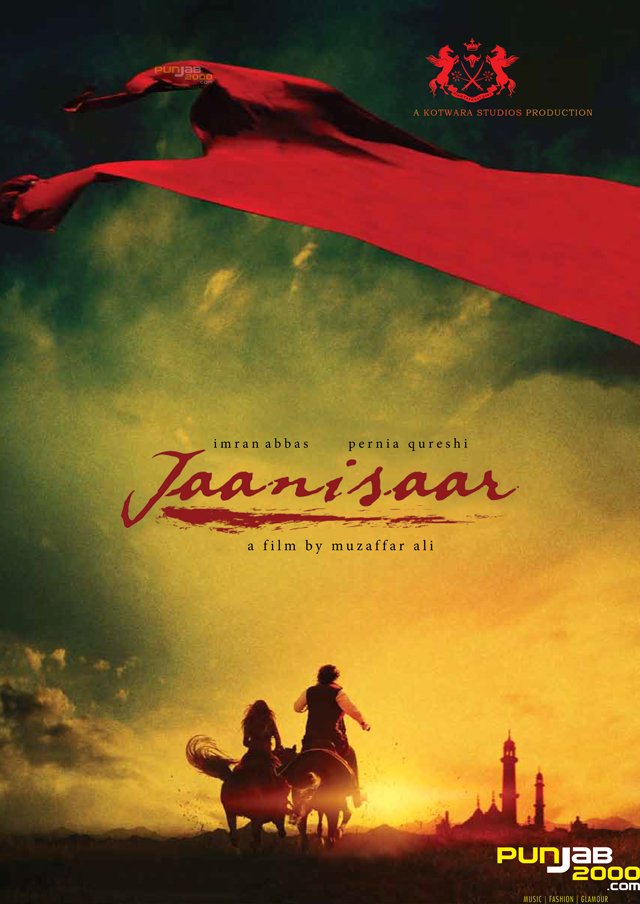
Jaanisaar
Jaanisaar is an epic on the conflict of cultures in the making of a British India post 1857
after the first war of Indian Independence. Set in 1876 on the soil of Avadh, in the heart
of India, the film explores the decline of its composite culture that seamlessly integrated
Hindu and Muslim identities.

Imran Abbas & Pernia Qureshi in Jaanisaar
The metaphor is the passionate love story between the
Anglicized Raja Ameer Haider and Noor, the fiery courtesan whose love for freedom is
stoked and sustained by underground revolutionaries.
Ameer, after the brutal murder of his parents, is taken to England by Sir John Cavendish,
where he grows up an Englishman, disparaging and ignorant of his own culture, values,
and lineage. Upon his return to India, Ameer falls for Noor.
Cavendish, incensed at this upsetting turn of events, manipulates Ameer’s grandfather, Kunvar Iqbal Hasan to prevail upon Ameer to marry a girl from the aristocracy and give up Noor.
A distraught Iqbal takes the help of his old beau, Mushtari Jaan, Noor’s mother, only to discover that it is too late; Noor, the protégé of Meer Mohsin Ali, a revolutionary and close associate of Ameer’s father, has already succeeded in transforming Ameer into the representative voice for the
freedom of India.
The stage is set for a complex and intriguing dénouement.
The film takes in its sweep not only the thunderous clash of ideologies and conflicting
intent but also the kindling of the flame of independence unrecorded in formal annals of
history.
Muzaffar Ali, celebrated and admired for his nuanced handling of script and direction,
leads us from the grand palaces of Imperial India and England to the lush forests of
Kotwara, on a fabulous, nostalgic journey, gently evocative and quietly breathtaking.
Music is the soul of the film with powerful poignant lyrics of Nawab Wajid Ali Shah, the
last king of Avadh, who lived in exile in Calcutta at that time and from Dr. Rahi Masoom
Raza’s epic poem ‘1857’ which takes the audience into the essence of that era. The music
has been created by Muzaffar Ali and the renowned maestro Ustad Shafqat Ali Khan
Filmography Muzaffar Ali
Muzaffar Ali’s award winning masterpieces have been rooted in history and culture of Awadh, India. Created with the
passion of a painter they spell a magic of music and poetry.
Feature Films
GAMAN, 1978, his 1st feature film on the problem of
migration from a rural milieu to an urban metropolis won
Silver Peacock Award at the 7th International Film Festival,
New Delhi, Filmfare Award for Best Director at the National
Film Festival with a Special Commendation of the Jury. It
was shown at Mannheim Film Festival, Germany and Indian
Panorama, International Film Festival, New Delhi.
UMRAO JAAN, 1981, is a bio-epic on the life of a 19th
century courtesan of Lucknow.
It won the Filmfare Award for Best Director, Best Music, Best
Playback Singer and Best Actress. It won Best Music, Best
Actress and Best Art Direction Awards at the National Film
Festival, New Delhi. It also received West Bengal Film Journalists
Association Award for Best Director. It was shown at
Moscow, Locarno, Pompidou Film Festivals amongst several
others.
AAGAMAN, 1983, treated the subject of the struggle of
sugar cane farmers to establish their cooperative mill with
great sensitivity.
ANJUMAN, 1986, a sensitive story on the exploitation of
Chikan embroidery women of Lucknow was shown at Cairo,
Vancouver, Tehran and Mauritius Film Festivals
ZOONI, under production, is based on the 16th century
legendary peasant poetess queen of Kashmir.
A retrospective of Muzaffar Ali’s films was held at IFFI, Goa
in 2010 featuring GAMAN, AAGAMAN and ANJUMAN
Television
Besides feature films, he has made 24 short films and 3 major
serials for television: Jaan e Alam – 13 episodes (1987), Husn
e Jaana – 27 episodes (1993), Zabaan e Ishq – 14 episodes
(2006)
Amongst his 20 music albums as composer, Raqs e Bismil
sung by Abida Parveen is best known.